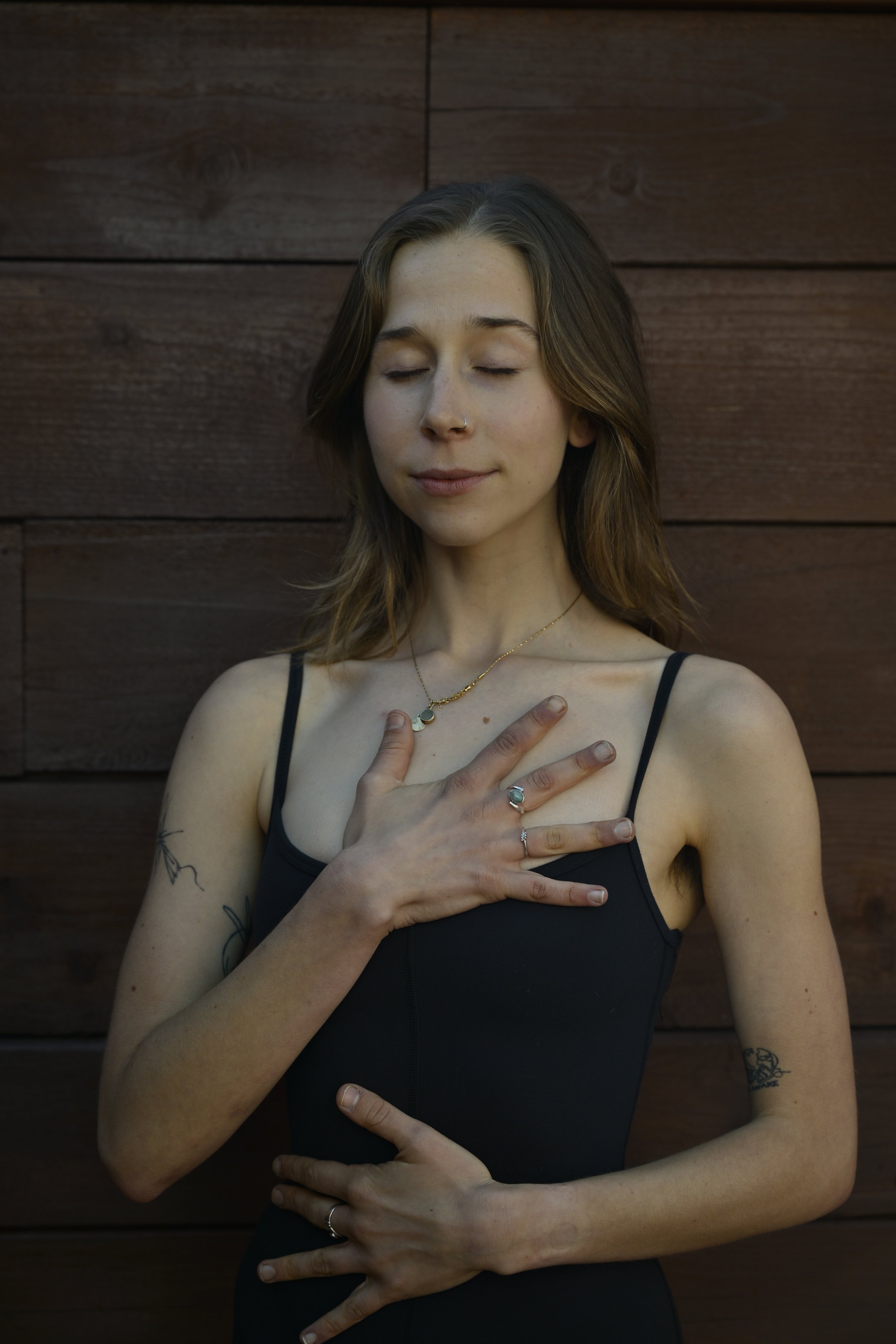
Welcome, friend
A Safer Space for Self-Discovery. Welcome to Activated Yoga.
True wellness belongs to everyone. As a trauma-informed and Accessible Yoga certified instructor, I aim to create supportive and inclusive environments for your personal practice. Whether through Hatha, Vinyasa, Yin or Restorative classes, my goal is to help you bridge the connection between your mind, body, and spirit, at your own pace.
Defined by a commitment to community-based wellness and an anti-oppression framework, my approach to yoga centers on empowerment and lived authenticity. I understand that navigating mental health and embodied trauma requires a specialized, somatic lens—and a great deal of courage. I am dedicated to providing the resources and supportive environment necessary for you to explore your own personal practice. As we build internal resilience and safety, we grow our capacity for kindness toward ourselves and our world.
I invite you to join me in this work of transformation.
My Story in Many Moving Parts
For years, I showed up to yoga before I ever really practiced it.
At the start, it was purely physical — a means to push myself, to discipline my body. I could hold out for ninety minutes in a Bikram room, but what I could not do was sit still or rest. What I understand now as a nervous system that had never learned to be somatically present, I experienced then as an aversion to anything that slowed me down enough to feel.
I was twenty-one, moving through a period of deep grief, and my strategy was simple: silence the body. Block everything out. Move.
It took the guidance of mentors and my community, years of study, and radical self-honesty, to understand that yoga begins when we start to listen.
As a living practice, yoga is relational at its core. At its heart is our capacity to be present with ourselves — and through that, to find greater presence with each other. We cannot be in healthy relationship with others when our relationship to ourselves is absent, even harmful.
I completed my initial 200-hour training in 2022. Studying its philosophy gave me language for an ethos I wanted to live by. The practices provided ritual, perspective, and tools for restoring a relationship with myself. I grew my capacity to sit with pain, with joy, and to embrace this messy world we all share.
Yoga gave me stability when I felt I had none.
In 2024, I fractured my vertebrae in a climbing accident. The months that followed were as much a mental test as a physical one. I was determined to recover full mobility, and yoga was central to that process.
But my spine healed out of alignment. Chronic pain, inflammation, and injuries began to accumulate. In 2025, I was diagnosed with Ehlers-Danios Syndrome.
Once again I found myself renegotiating my relationship with a body I had worked so hard to love. The pain and grief still tempts me to dissociate — and again, I turn to yoga.
I am building a practice for myself that is kinder, more wholly informed. I let my practice transform. I allow seasons of strong asana, of sedentary meditation, of learning, of simply being in community.
I never abandoned the practice. I let it become what I needed to be.
These experiences shape the teacher I am becoming. My prior work in politics and advocacy, my lived experience of injury, grief, and chronic illness, and my ongoing study of trauma-informed and accessible approaches have all moved me toward one clear intention: to hold space for people to come home to their bodies, on their own terms, in their own time, informed by their own stories.
-
Regardless of style, level, or setting, these are the things I bring to every class I teach.
-
My classes are intuited by the group in front of me — which means I'm watching, adapting, and checking in. I will do my best to remind you that you belong and that you are seen.
-
Touch and physical assists will always be offered, never assumed. I ask before I adjust, and no is a complete sentence — one that changes nothing about the care and attention you receive.
-
Blocks, bolsters, straps, walls, chairs — these aren't just for modification. Props are tools that make the pose yours. Everyone gets to use them. No one has to ask.
-
I offer ta path to the practice. You walk it. Every cue is an invitation to explore — to try something, stay somewhere, or skip it entirely, but there's no single right way to be in your body, and I encourage folks to take the practice in their ow direction
-
My trauma-informed and accessible yoga training are my lens through which I teach everyone. every body carries a history, and every person deserves a practice built around their wholeness.
-
This is a movement toward collective liberation. Our health is indivisible from the health and wellbeing of the world. That requires action and conversation and accountability. Together, let’s take our yoga off the mat, and into the world.
Activated Yoga
A Home for the Political Yogi
I often speak about dharma — the guiding principle of ethical action and right relationship. For me, dharma is the bridge between the mat and the world. It is the understanding that personal healing and collective liberation are deeply interconnected. If my practice calls me toward compassion, nonviolence, equity, and care, then my yoga must express those values through action.
The personal has always been political for me.
I am queer, and my rights and safety are shaped by policy, culture, and law.
I am a woman, and autonomy over my body remains publicly debated and legislated.
I live with Ehlers-Danlos Syndrome, making access to healthcare both essential and often difficult to navigate.
I am a survivor, which has deeply informed my understanding of violence, justice, education, and community accountability.
And I am a yoga teacher, which means the wellbeing of my students does not begin and end at the studio door.
Yoga, to me, cannot be separated from the conditions people are living within.
Before fully stepping into teaching, I received my degree in political science and worked in political research and advocacy spaces for several years. Though my work has evolved, my commitment has not. I continue that practice through one-on-one care, community organizing, teaching incarcerated youth, supporting local mutual aid and wellness initiatives, and creating spaces where people can reconnect to themselves and one another through embodied practice.
“Home for the Political Yogi” is rooted in the belief that yoga is a path to being fully present within the world and with each other. It is a space for people who believe healing and justice belong together. A space for questioning, learning, grieving, growing, organizing, resting, and returning to community.
I am committed to the radical work of somatic care and to advocating for a world where we prioritize people over profit, connection over extraction, and collective wellbeing over individual performance.